Remedium ferendarum iniuriarum, sive de compescenda ira
Autore: DONZELLINI, Girolamo (ca. 1513-1587)
Tipografo: Frescesco Ziletti
Dati tipografici: Venezia, 1586

A NICODEMITE, ETHERODOX RELIGIOUS DECLARATION DISGUISED IN THE FORM OF A PHILOSOPHICAL-MEDICAL TREATISE DEDICATED TO AN INQUISITOR
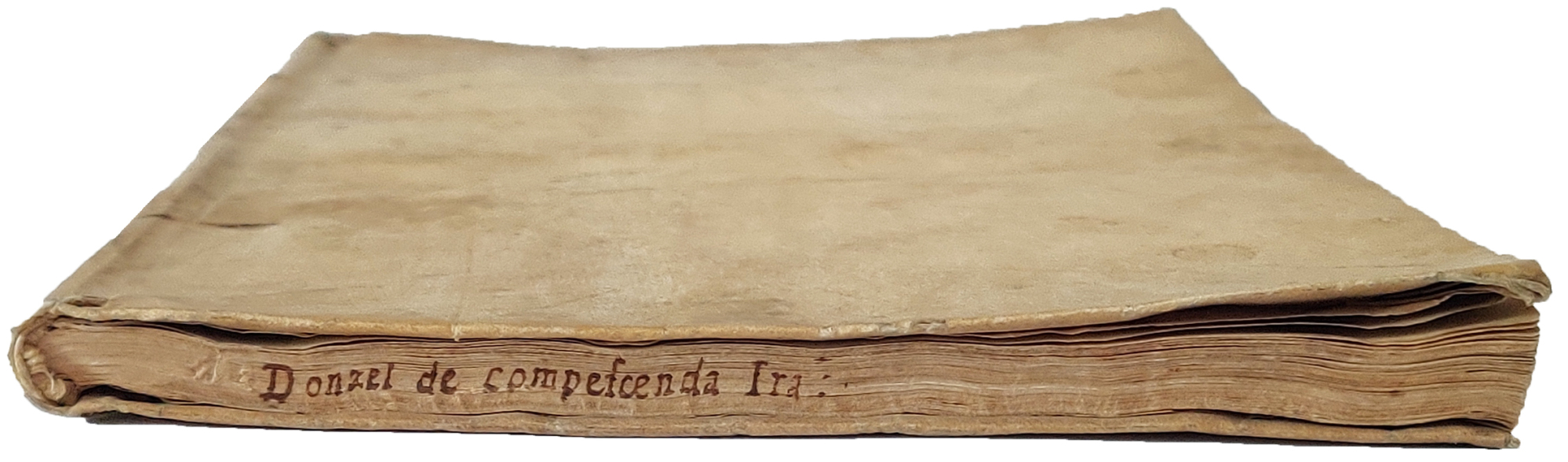
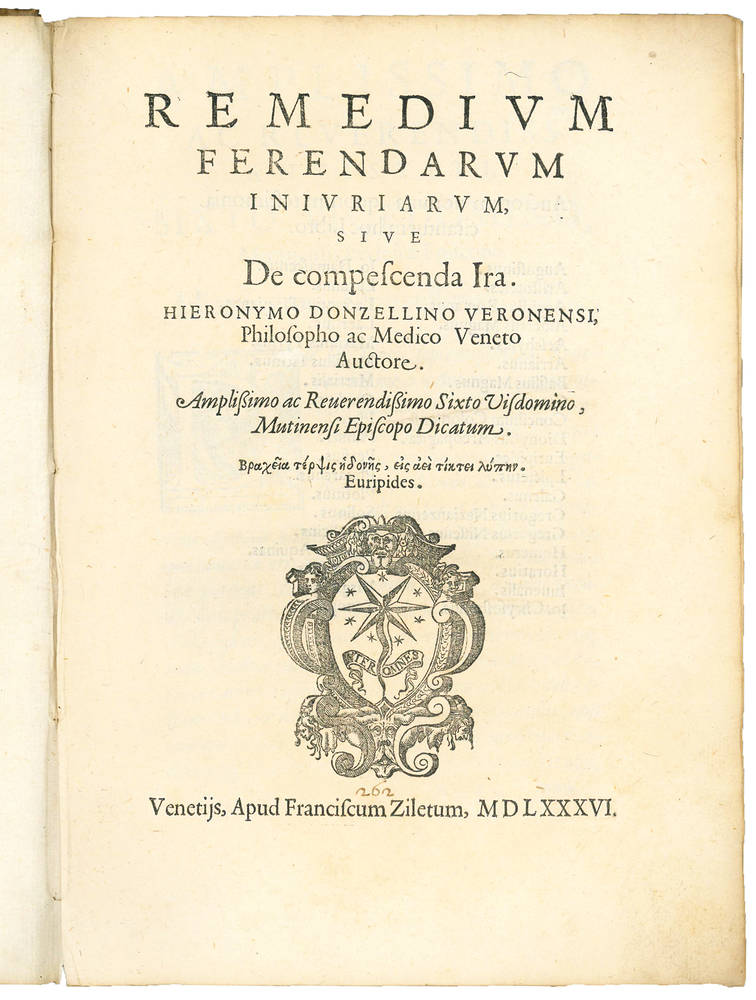
4to (245x175 mm). [8], 55, [1 blank] leaves. Collation: *-**4 A-O4. With the printer's device on the title page. Roman and Greek types. Contemporary flexible vellum with inked title on spine and lower edge (small losses to spine). Skillfully repaired worm track to the inner upper margin of a few leaves at the beginning of the volume, a couple of quires slightly browned, all in all a very good, genuine copy with wide margins.
Rare first edition (a second was issued in Altdorf by Nikolaus Knorr in 1587 and a third in Leiden by Joannes Maire in 1635) of this treatise on how to bear injuries and find a remedy against wrath. By the time Donzellini's wrote his last work, he had been through repeated examinations and torture at the hand of the Inquisition, but also over the course of his life he had received many injuries for his religious beliefs and from his medical enemies upon which to reflect. Under the compulsion of wrath, humans behave as beasts. Donzellini asserts that nothing is more harmful to humans than anger and the lust for vengeance. His treatise evokes interest because of the manner in which he selectively interwove the ideas of others. He was not the first author to have considered the subject of man's response to injuries. Aristotle, the Peripatetics, Stoics and Epicureans had addresses this issue, but not a central concern for them as it was for Donzellini (cf. C.L. Redmond, Girolamo Donzellino, Medical Science and Protestantism in the Veneto, Stanford, CT, 1984, pp. 198-231).
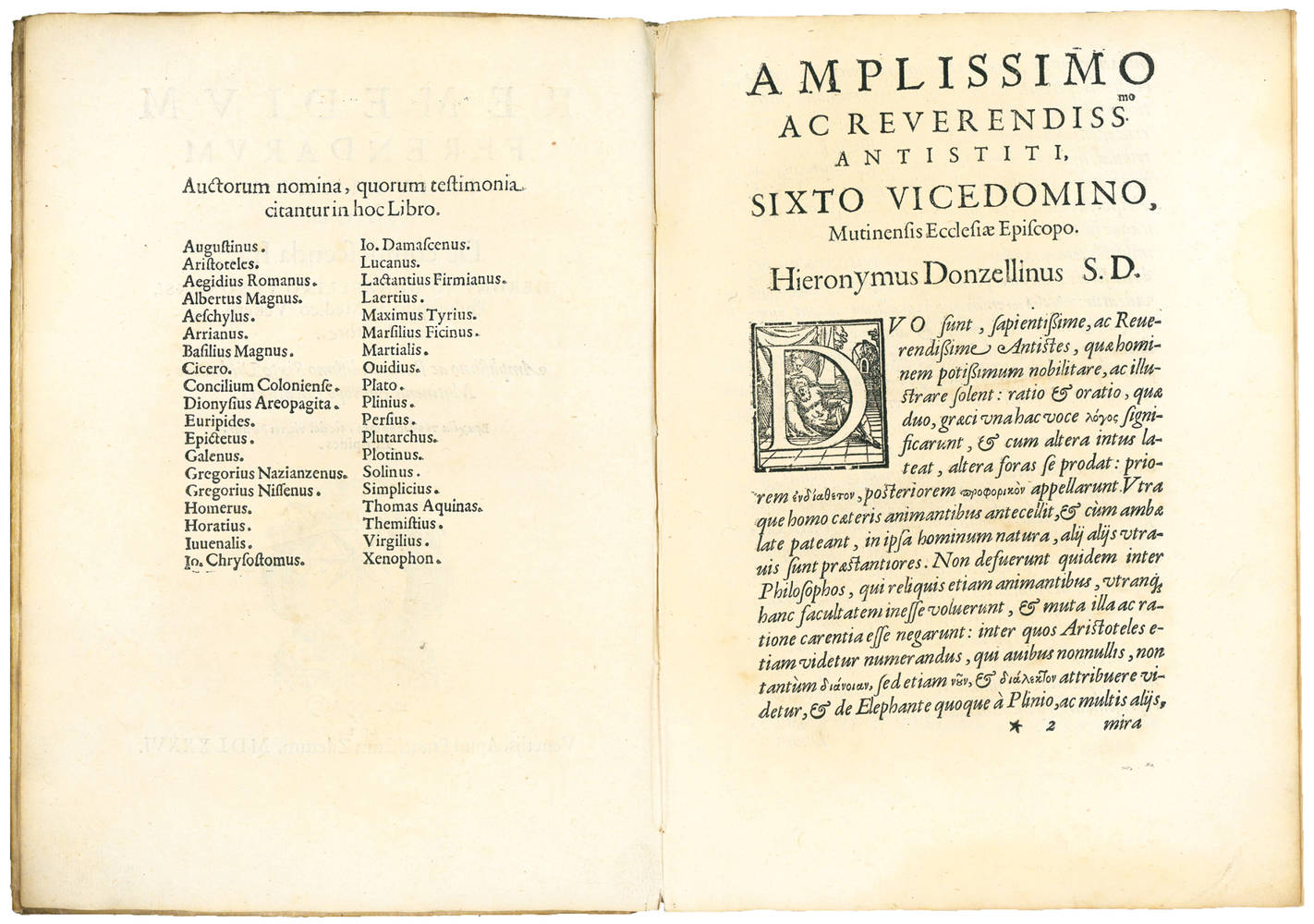
“Donzellini's interest in Paracelsianism needs to be contextualised against the backdrop of the physician's philosophical attitude and his fascination with Hermeticism and emanationism. In this respect, Donzellini's most significant philosophical output is his Remedium ferendarum iniuriarum, sive de compescenda ira. Drafted in 1586, only a year before his execution, this tract offers both physical and philosophical analysis of the issue of anger. The stated aim of the work is to promote values of temperance, concord, and love among men by teaching forgiveness and tolerance of offences. To this end, the text blends philosophy, theology, and medicine, with a marked emphasis on the former two. Due to its hybrid nature, the density of its content, and the time of its drafting, the Remedium is an excellent anthology of Donzellini's philosophical, religious, and medical ideas. It reveals the extent and manner in which his intellectual profile was influenced by these different aspects. Moreover, it showcases his propensity for a humanist religion that took on potentially subversive overtones in the late Cinquecento. These radical implications and the choice of subject matter suggest that the tract was drafted as a militant work. In this sense, its call to conquer irascibility takes shape as a metaphor for the desire to overcome confessional disputes and the defence of religious tolerance. The text was published by Francesco Ziletti, a printer who played various roles in Donzellini's network […] The Remedium was a complex text because it could be used and interpreted on different levels and offered a variety of approaches for analysing the subject of anger and bearing injuries. It joined a series of humanist treatises on wrath, with a flurry of works produced during the sixteenth century: the philosopher Agostino Nifo, the physician Johann Weyer and, later, Justus Lipsius and Michel de Montaigne all wrote on the matter, often absorbing the influence of Plutarch's De cohibenda ira (On the Control of Anger) and Seneca's De ira (On Anger). For Girolamo, however, the theme of bearing injustice also struck a personal chord. After all, he had been persecuted, imprisoned, and deprived of the dignity of his profession on two occasions. He explained in the Remedium that surrendering to rage – the most dangerous of all passions – could never be justified, even by victims of the worst iniquities. This insight takes on a dramatic significance in the light of his personal experience and, as Alessandro Arcangeli pointed out, it is certainly feasible that the unjustly prosecuted people mentioned in the text, bravely enduring humiliation, were references to his own troubled legal history. The focal points of the treatise, however, are not of a personal nature. Starting from his dedication to Sisto Visdomini, Bishop of Modena, Donzellini structures his discourse around the subject of the dignity of man, emphasising above all the value of the word. He sees human beings as superior to other animals because of their use of reason (ratio) and discourse (oratio), which can also be expressed with the Greek term λόγος (logos). The word is the essential agent of salvation. Indeed, the ‘light of the gospel' was revealed to humankind through the verbum (word, logos), thereby enabling a new pact with God. The very fact that Christ is referred to as the Logos – ‘the word, namely discourse, language' (‘verbum scilicet, sermo, oratio') – shows the value of the word, through which man can express his thoughts and thereby prevent discord and violence. The emphasis on the literal meaning of logos recalls the teachings of Lorenzo Valla and Erasmus of Rotterdam. The celebration of the word, a gift from God, was widespread in circles that blended humanism, which favoured a philological interpretation of Scripture and valued human reason, with the ‘vibrant and mystical religiosity of the Reformation.' In these contexts, which mainly consisted of Italian exiles that Donzellini had encountered in various ways, humanism took shape as the fundamental agent of a form of heterodoxy that could not be reduced to the dictates of Lutheran or Calvinist doctrine. Besides the general element of continuity with humanist sensibilities and theology, the influence of Platonic thought is apparent throughout the Remedium; as the author informed his friend Zwinger, the work was envisaged as a counterpoint to the Aristotelian tradition. Platonism is openly defined in the treatise as ‘intellectual religion' (‘doctam religionem') and Platonists are classed as those who ‘were almost Christians' (‘paucis demptis fieri christianos') […] Girolamo underlines the harmony of all religious and philosophical systems, and the continuity of doctrine. Acknowledgement of this would enable religious peace, as he had already affirmed in the preface to the orations of Themistius through the concept of the docta religio. Above all, Donzellini draws on the philosophical tradition inaugurated by the Platonic Academy of Florence, founded at the initiative of Marsilio Ficino in 1462. The image of the divine set forth by Donzellini makes explicit reference to the thinking of Ficino, who had also been a physician before he concentrated on teaching theologia platonica (Platonic theology). In this perspective, God cannot be seen with the eyes or expressed in words; he can only be approached through regular meditation and the celebration of his mysteries. The contemplation of divine mysteries kindles a light in the human soul, almost like a spark flying off burning wood, which gradually becomes larger and stronger. In addition to its echoes of Neoplatonism, this mystically inclined allusion reflects Girolamo's familiarity with the Valdesian doctrine. Like an ‘incorporeal and infinite Sun' (‘Sole incorporeo, infinito'), God permeates every aspect of reality. Through a process of emanation, God ‘is all in all' (‘est omnia in omnibus'). Being present in all men, he shares all good with them. In this process, men become like God and partake of his blessedness […] Against the backdrop of the spread of confessional controversy and the Church of Rome's repressive response to the growth of heresy, the revival of a philosophical tradition steeped in Neoplatonism could have implications of heterodoxy. To safeguard Catholic orthoorthodoxy it was essential to maintain a closed, structured cultural system based on the certainties of Scholastic-Aristotelian philosophy […] Although he always remained within the boundaries of orthodoxy and never directly questioned the Trinity, the Neoplatonic emanationist doctrines that he championed and Donzellini followed featured an underlying immanentist concept of divinity that encouraged a modalist interpretation of the Trinity […] Donzellini's references to Ficino featured the same positive anthropology, which attributed man with divine potential and a central role in God's plan. In this respect, Donzellini's interest in Paracelsian thought assumes greater significance. Paracelsus had revisited some aspects of Neoplatonism, highlighting their pantheistic repercussions, and his peers had judged that his conception of the cosmos damaged the Trinitarian dogma by viewing the Son as ‘a corruptible substance.' The same concepts were also present – through reference to Ficino and the Hermetic tradition – in the work of Servetus, another radical physician whose thinking Donzellini mirrored in many respects. First of all, both referred to the so-called negative theology and the image of an ‘invisible and inexpressible' God. Second, they offered identical solutions to the ineffability of God: a ‘metaphysics' (‘metafisica') of light that mediated ‘between the divinity, from whence it emanated, and the world, which it constituted.' Thirdly, they both conceived of the sun as a sign of divinity (symbolum deitatis), a visible and ‘corporeal' image of the Eternal underpinned by the idea of a God spilling into reality. Finally, the two physicians each adopted the Pauline expression of God as ‘all in all' (‘omnia in omnibus'). In the wake of the Hermetic tradition, this took on pantheistic overtones that could not be reduced to the original meaning found in the Epistle to the Corinthians. Donzellini, however, also employed an image verging on pantheism when he described the divine nature as ‘a sphere whose centre is everywhere.' The interpretation of the verbum as the concrete means through which God had revealed himself to the world (as a “quality” or provision of the divine rather than a res, or substance) was also similar in some respects to the theology of Servetus, which in turn drew on Lorenzo Valla. In the works of both Servetus and Donzellini, the humanity of Christ was the fundamental element of mediation between the human and the divine. God had revealed himself through the incarnation of the Son-Logos, thereby redeeming man, his favourite creature. Donzellini used the term θεάνθρωπος (theanthropos) to describe the God-Man ‘endowed with divinity' by the Father. On one hand, this emphasised the humanity of Christ, never mortified by his divinity; on the other hand, it highlighted the supremacy of Christ in the eschatological discourse. This notion was consistent with Servetus's anthropocentric and Christocentric vision. Donzellini also stated that after the creation of the world (mundo condito), God decided to make himself visible through the Word (verbum); until that moment, he had been ‘hidden in the immense and infinite sea of eternity.' Even with the ambiguity of this statement, which glosses over the vexed question of the generation of Christ, he seems to be suggesting that the Son-Word was generated over time, after the creation of the world. This would endorse Servetian Christology, according to which ‘the Word was eternal. The son of God was not eternal.' In other words, the Son – the incarnation of the Word – was inferior to God the Father despite being retrospectively endowed with divinity […] While these similarities are not enough to describe Donzellini as an anti-Trinitarian - and there is no intention to do so -, they nevertheless suggest that he was both familiar with and partly inspired by the Spaniard's work. Indeed, it has been established that Girolamo first encountered Servetus's texts before 1554 when he stayed with Pier Paolo Vergerio in Tübingen at the beginning of his exile on Reformed soil. In Vergerio's aforementioned letter to Bullinger, he mentioned that his guest had been ‘tempted' towards the Servetian ‘plague' (‘peste') by the radical jurist Matteo Gribaldi Mofa in Padua. Pietro Perna also provided Donzellini with some of the Spaniard's texts, although we do not know which. It is feasible that they were the De trinitatis erroribus and the Dialogi de trinitate (Dialogues on the Trinity, Hagenau, 1532), which had been available in the Venetian heterodox world since the 1530s. After Servetus was burned at the stake, the Protestant Churches and the Catholic authorities launched such a relentless campaign to eradicate the Christianismi restitutio (an anthology of his theological and cosmological ideas in which his debt to the Neoplatonic tradition is apparent) that there are now only three surviving copies. Nevertheless, the Christianismi restitutio was distributed in manuscript form, above all in Padua and in academic medical circles. The text might have raised particular interest among Doctor of Arts and medicine because it announced the discovery of the pulmonary circulation of blood and prompted curiosity in new doctrines that were widespread in the medical community. Moreover, Servetian ideas are known to have circulated in Basel since the 1530s. These aspects all strengthen the hypothesis that Donzellini could have read the Spaniard's theological treatises – both his writings from the 1530s and his masterpiece of 1553. It is likely, however, that the Trinitarian dispute was of no interest to him, a mere adiaphoron that had already caused too much bloodshed and produced schisms that were inevitably negative from his irenic perspective. In this respect, the lack of any attempt to solve the mystery of the generation of Christ or interpret the passage of the Gospel of John (‘In the beginning was the Word') is in keeping with the basis of his religiosity. To this end, the references to the nature of the Verbum and its importance in practical teaching, despite its divine origin, aimed to establish a form of Christianity reduced to moral law that would focus on the imitation of Christ and the practice of neighbourly charity and love. Donzellini thus joined the tradition of Christian humanism that had moved from Ficino and Erasmus to Valdés and Servetus and culminated in the ethical religiosity of Socinianism. The essential element of Christ's preaching – of the verbum – was the proclamation of eternal blessedness for the humble, the meek, the peacemakers, and the persecuted. In this way, Donzellini combined a mystical and pantheistic approach with a view of Christianity based on the notion of φιλανϑρωπία (philanthropy), a ‘law of nature' grounded in love, benevolence, charity, and humility whose righteousness could never be repudiated. He explained that this universal law – the ‘healthiest' (‘saluberrimo') precept for building interpersonal relations – had been established on earth by Christ, the God-Man, through his preaching and exemplary conduct. However, this was a law etched into the human mind in all populations throughout the ages (as Paul had written in Rom 2:15) that had already been effectively interpreted by Gentile philosophers: Plato, Aristotle, and above all Socrates, the first to state that philosophy ‘is to become like God.' The nexus between philosophy and religion was thus not only expressed in theological terms but also reiterated in relation to moral doctrinal content. From this point of view, the proper remedy for dealing with offences is seen as compliance with the evangelical teachings and the law of nature, namely philanthropy. True Christians must be able to tolerate the abuses of others and all forms of insult; only in this way will they be worthy of their nature as God's chosen creatures at the centre of the universe. Therefore, after broaching the main issue of the treatise – the bearing of injuries –, Donzellini continued to embellish his pedagogical and moral intent with theological and philosophical ideas. The key to understanding the Remedium lies precisely in this interweaving of cultural motifs, held together by specific notions of the divine and of man and aimed at creating unity among humankind. The concept of ‘providence' (‘providentia') is also adopted to argue that the right way to address injustices is to use reason and the word, appeal to mutual dialogue, and contextualise the harshness of afflictions. Adversity is indeed part of the divine plan, with God as the ‘choreographer' (‘choragus') in a world-theatre in which every individual plays a role. God has given a specific task to every person on earth, each of whom is an instrument of his unquestionable will: emperors, kings, and princes just as much as peasants, the crippled, and ‘parasites' (‘parasiti'). In this framework, however, man is not abandoned to his fate or denied the freedom to lead a righteous life. Indeed, God decided to express his will through Christ, who provided a supreme model of virtue and benevolence with his preaching and conduct. In a context where the positions of mutual hostility adopted by the different confessions had become even more rigid, Donzellini launched a heartfelt appeal for the end of discord and persecution, for love among men, and for philanthropy. As a seasoned Nicodemite, he expressed his religious proposal in the form of a philosophical-medical treatise dedicated to an inquisitor (Sisto Visdomini, also Bishop of Modena) so as not to arouse suspicion. The same dedication, however, also praised the memory of Cardinal Giovanni Morone, the former Bishop of Modena who had been extremely close to Cardinal Pole and had played an active role in distributing the Beneficio di Cristo. Considering that Donzellini had been subjected to several trials and that the cardinal had also fallen afoul of the Inquisition, it seems significant that this reference appeared in a treatise celebrating those who had been unjustly persecuted and suffered trespasses against them with dignity and forbearance. Donzellini wrote in Latin and ensured that the text was also distributed beyond the Alps (as shown by the frequent mentions of the work in his correspondence with Zwinger). Indeed, his appeal was directed equally at the Catholic and Reformed worlds. It was on Reformed soil that the work was reissued forty years later – in 1635 in Leiden – by the printer Ioannis Maire, known for his editions of Erasmus, Kepler, and Grotius, and for first publishing Descartes's Discors de la Méthode (Discourse on the Method). This came at the height of the carnage of the Thirty Years' War, a time when Calvinism was convulsed by heated theological debates and fierce clashes. The reissue of the Remedium by a printer at the cutting edge of scientific and theological publications cemented Donzellini's intellectual legacy and ensured that his call for harmony among men, religious tolerance, and free scientific research did not completely fall on deaf ears” (A. Celati, The Remedium ferendarum iniuriarum between Neoplatonism and radicalism, in: “The world of Girolamo Donzellini. A network of heterodox physicians in Sixteenth-Century Venice”, London-New York, 2023, pp. 176-183).
Girolamo Donzellini, a native of Orzinuovi near Brescia, was a scion of an illustrious family of Verona. He made his first studies at Brescia and then matriculated at Padua University obtaining a degree in medicine in 1541. In the same year he started to teach theoretical medicine at Padua, where his colleagues were Giovanni Battista da Monte and Andreas Vesalius. In 1543 he moved to Rome serving Giulio Della Rovere and Durante Duranti. Here Donzellini got involved with persons suspected of heresy and frequented the circles of Pietro Antonio di Capua and Diego de Enzinas. After warnings from friends, he left the service of Cardinal Durante and went to Venice. The atmosphere of that city proved to be more responsive to Donzellini's Protestant beliefs. He practised medicine, what allowed him to communicate his religious convictions for a while before beginning to evoke suspicion. He then fled from Venice in 1553 before he could be questioned by the Inquisitional tribunal, first stopping at Ferrara to visit the duchess Renée, and then proceeding to Germany where he met Pier Paolo Vergerio in Tübingen (cf. M.L. Portmann, Der Venezianer Arzt Girolamo Donzellini etwa 1527-1587 und seine Beziehungen zu Basler Gelehrten, in: “Gesnerus”, 30/1-2, 1973, pp. 1-6).
Serious family matters brought him back to Brescia in 1560. He appeared spontaneously before the Holy Office in Venice in November of the same year, and in February 1561 abjured his errors. He was condemned to a year of imprisonment, but most of the sentence was suspended. He moved to Verona and became a member of the local medical college. However, the Inquisition brought him to trial a second time in 1574, and this trial, much more than the first, revealed the extent of his involvement with heretics and heretical doctrines. He abjured for a second time in 1575 and remained in the Inquisition's prison until 1577, when he was released after the plague ravaged in Venice. Donzellini was then allowed to practice medicine again, and he pursued his career until his final encounter with the Holy Office in 1587, when prohibited books were found in his home. Shortly afterwards he was sentenced to death and executed by drowning.
Donzellini's numerous relations abroad as well as in Italy are indicative of the breath of his contacts and his general reputation as a physician and author of medical writings. He sometimes disguised himself under the pseudonym of Eudoxus Philaletes (cf. C.L. Redmond, Girolamo Donzellino, Medical Science and Protestantism in the Veneto, Stanford, CT, 1984, passim; see also R. Palmer, Physicians and the Inquisition in 16th Century Venice, in: “Medicine and the Reformation”, O. P. Grell & A. Cunningham, eds., London, 1993, pp. 122-125; and E.A. Rivoire, Eresia e Riforma a Brescia, in: “Bolletino della Società di Studi Valdesi”, CV-CVI, 1959, pp. 33-90).
Edit 16, CNCE17743; USTC, 827673.
[11351]